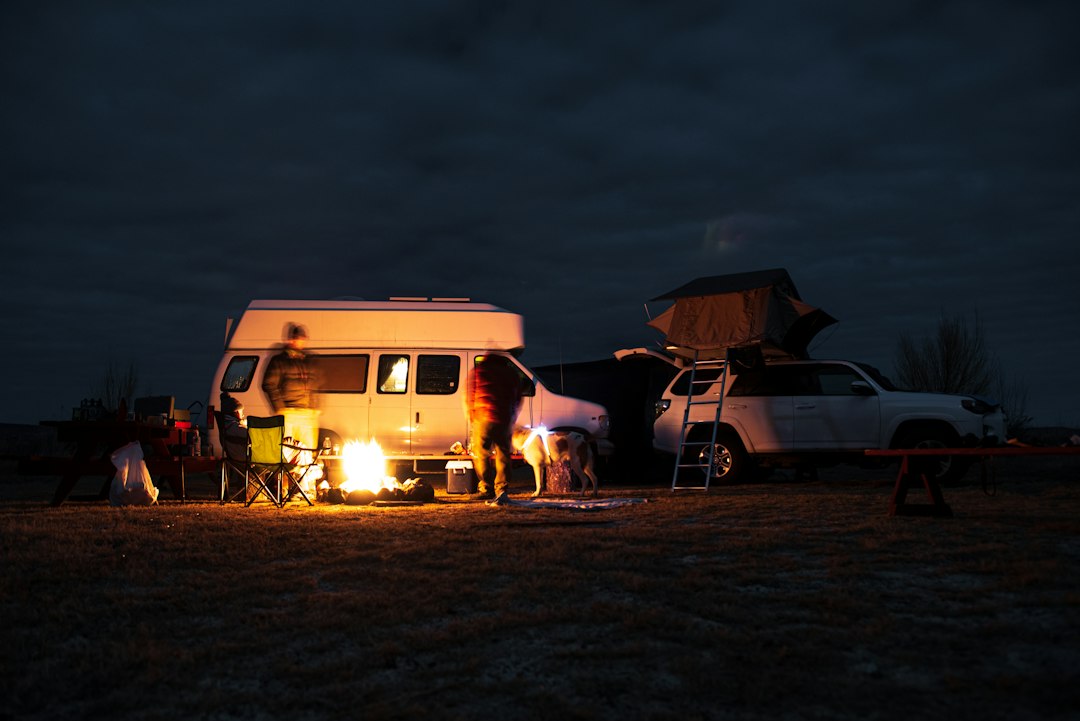
The first time I tried to make dinner out of the back of a vehicle in real cold, the stove lost before I did. It was a little after five at a pullout in the high desert, already dark, maybe 25 degrees and dropping. I screwed a fresh butane canister into a one-burner stove, clicked the igniter, and got a flame about the size of a birthday candle. Fifteen minutes later the water in my pot was warm enough for a bath and nowhere near a boil. I ate the ramen crunchy, in the driver’s seat, with the heat running.
The cold wasn’t the problem. Butane is. It stops vaporizing well right around freezing, so the colder the night gets, the weaker the flame. So this season my team and I are building the road-trip kitchen around something most of us already have parked in the driveway: a vehicle with a real 120-volt outlet, or a power station that can act like one.
Induction cooking off a truck or battery used to be a van-life curiosity. Now plenty of pickups and EVs can push a couple thousand watts out of a household-style plug. With Black Friday on November 27 and the holiday driving season right behind it, this is a good month to figure out what your vehicle can actually run, and what’s worth buying to cook off it.

The Short Answer Before You Shop
- Read your outlet’s rating before buying anything. A plug that looks like a wall socket can be capped at 400 watts or rated for 2,400. The number in your owner’s manual decides everything else.
- Match the burner to the outlet. Most portable induction burners max out around 1,800 watts. If your outlet tops out at 1,500, buy a burner that lets you cap its power, or plan to cook on medium.
- Check the pan with a magnet. If a fridge magnet won’t stick firmly to the bottom, the pan won’t heat on induction. Cast iron, carbon steel and most magnetic stainless will.
- A power station needs two numbers. Continuous AC output above the burner’s draw, and enough watt-hours for the cooking you plan to do.
- Never run an engine to cook anywhere enclosed. Open air, tailpipe pointed away from people, and the cooking happens outside the cab.
Why Canisters Fade When the Thermometer Drops
I still love a gas stove for backpacking. But on a winter road trip there’s a big battery on wheels within arm’s reach, and straight butane boils at about 31 degrees Fahrenheit. Below that, the canister has trouble turning liquid fuel into gas, and as you cook, the canister chills itself even further. Isobutane and propane blends do better, and a big green propane bottle does better still, but propane brings its own mess: bulky cylinders, regulators that freeze up, and fuel stored in a car full of people and presents.
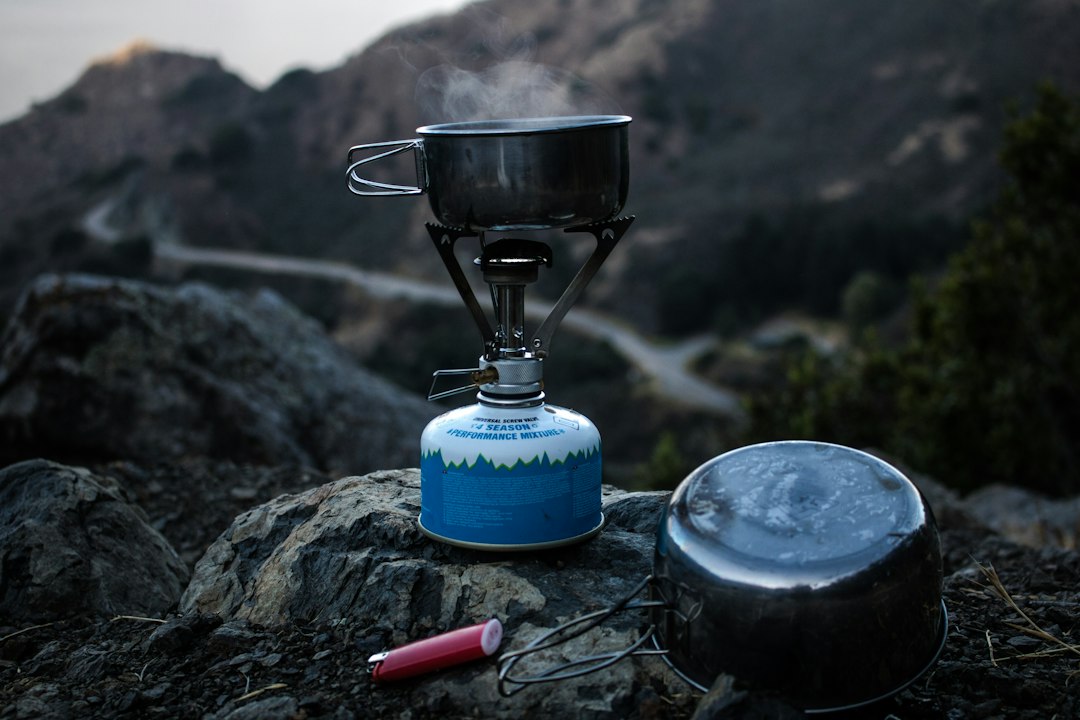
Induction doesn’t care about the temperature outside. It runs on electricity and heats the pan directly through a magnetic field, so very little heat is wasted warming the air around the pot. On a breezy night that matters a lot. There’s no flame for the wind to push around, and lifting the pot off stops the heat.
What Your Outlet Can Actually Run
This is where most people either overbuy or get disappointed. Vehicle outlets fall into rough tiers, and the same truck model can carry very different hardware depending on trim.
The 12-volt socket. The old cigarette-lighter socket is usually fused around 10 to 15 amps, which works out to roughly 120 to 180 watts. Fine for a phone or a cooler, useless for an induction burner no matter what a plug-in inverter box claims.
The 400-watt household outlet. Plenty of trucks and SUVs have a 120-volt outlet in the console or bed that tops out around 400 watts. Ford calls its version Pro Power Onboard 400 W, and it’s standard on a lot of its trucks and SUVs. Good for a laptop, not for cooking.
The 1,500-watt tier. Rivian’s R1T and R1S have built-in 120-volt outlets, but the owner’s guide says not to plug in anything over 1,500 watts. That’s enough to cook, but only with a burner that can be capped below full power.
The 2,000-watt-and-up tier. This is where cooking gets easy. Ford offers 2.0 kW and 2.4 kW Pro Power Onboard systems on several trucks, and the F-150 Lightning starts at 2.4 kW and goes to 9.6 kW on extended-range trucks. The Cybertruck has outlets in the cabin and bed, and Chevy’s Silverado EV offers even more. In August, Tesla switched on 2.4 kW vehicle-to-load for the Model Y Premium in the U.S. using an $80 adapter that clips onto the mobile charging cable. Hyundai and Kia have sold charge-port V2L adapters for years. Output varies by model and outlet, so check the manual for your car.
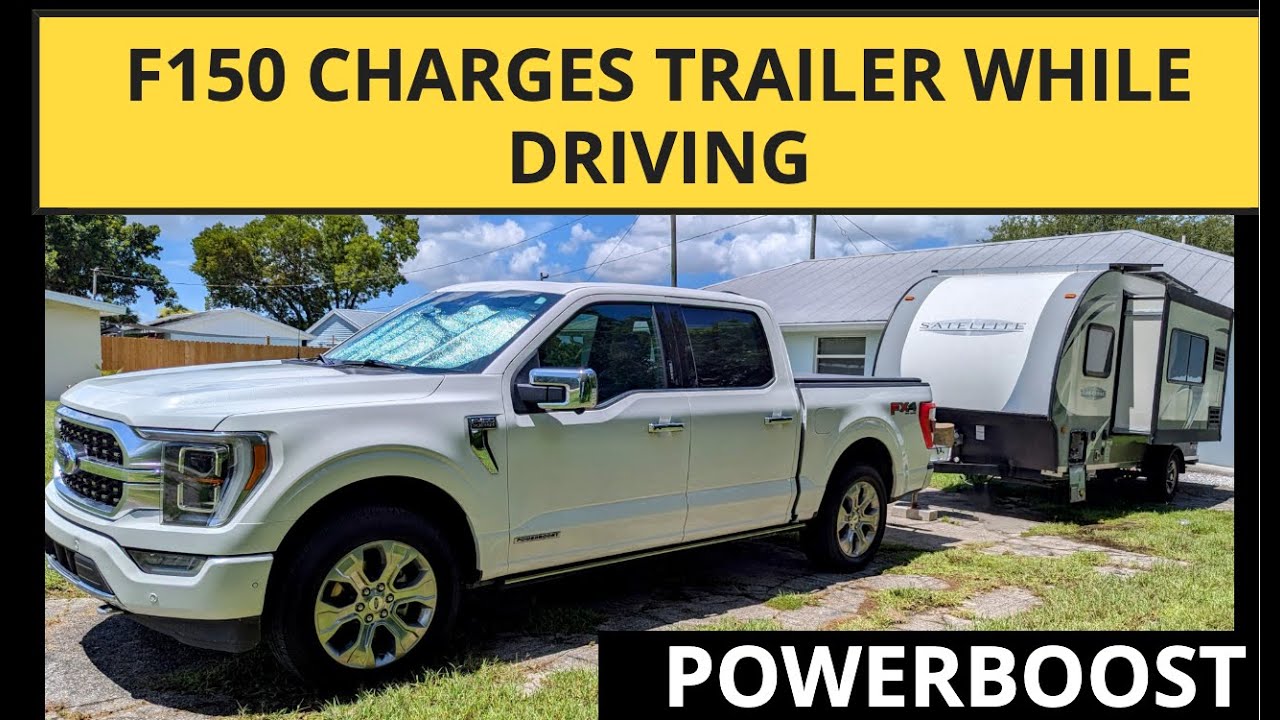
Our own 2021 F-150 PowerBoost carries the bigger 7.2 kW system, and we’ve pushed it harder than any cooking setup will. In F150 PowerBoost Charging Camper Trailer While Driving on the Make Someday Today channel, you can watch the truck feed a travel trailer’s battery bank as it rolls down the road. One detail from that build matters here. The truck’s in-cab outlets share a circuit with one leg of the big 240-volt outlet, so we moved the trailer cable to the other leg to keep the cab outlets free. If your truck has more than one outlet group, find out which ones share a breaker before you plug a burner and a kettle in side by side.
The Tailgate Kit I’d Actually Pack
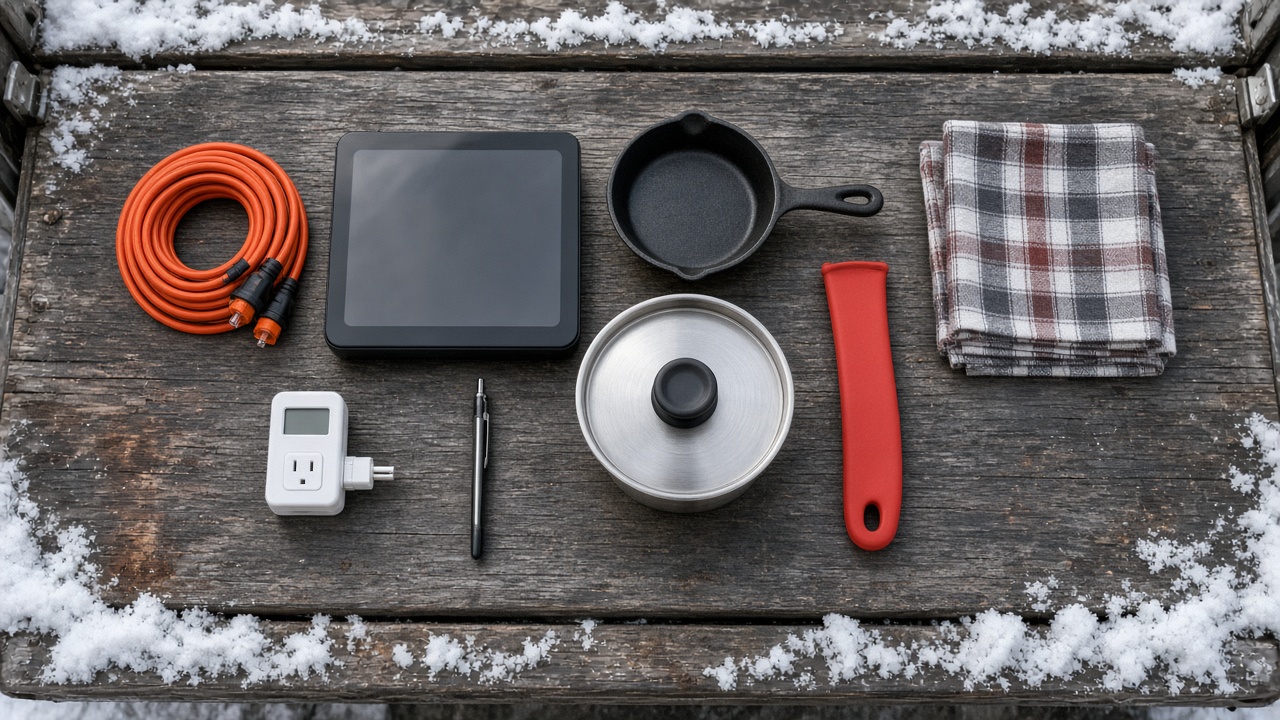
For a vehicle with at least 1,800 watts on tap, the burner I keep coming back to is the Duxtop 9100MC Portable Induction Cooktop. Nothing about it is fancy. It’s 1,800 watts at the top, with ten power levels that run down to about 200 watts and simple buttons that work with gloves on. If your outlet is capped lower, like the Rivian’s 1,500 watts, look at the Nuwave Gold Precision Induction Cooktop instead. It tops out at 1,500 watts and can be locked to 900 or 600 watts, so it won’t trip the inverter halfway through a pot of chili.
Next, a cord. Vehicle outlets are rarely where you want to cook. They’re in the bed wall, the frunk or under a seat. A short, heavy cord is safer than a long, thin one, and I carry an Iron Forge Cable 12-Gauge 25-Foot Outdoor Extension Cord for exactly this. Unspool it fully. A coiled cord under a heavy load gets warm.
Then a surface. A burner on a tailgate is too low for comfort, and a burner on a snowy picnic table slides. The GCI Outdoor Slim-Fold Cook Station folds flat behind the seats, stands at counter height, and has a side shelf for the cutting board. I keep the induction burner on the main surface and everything wet on the side shelf, away from the controls.
Finally, one cheap tool that ends arguments: a P3 Kill A Watt Electricity Usage Monitor. Plug it into your outlet, plug the burner into it, and you’ll see exactly how many watts each setting pulls. My team was surprised how far below the rated maximum the middle settings pulled.
Pans That Pass the Magnet Test
Induction only heats pans with a magnetic base. Your thin aluminum camp pot won’t work, and neither will most hard-anodized nonstick. Test what you own with a fridge magnet first.
If you need something new, a Lodge 10.25-Inch Cast Iron Skillet is the honest workhorse. It’s heavy, but it holds heat when cold air rolls across the table. Slide a Lodge Silicone Hot Handle Holder over the handle. A cast-iron handle gets hot enough to burn you, and your mittens will be in the truck.
For something lighter that still sears, I’ve come around to carbon steel. A de Buyer Mineral B Carbon Steel Fry Pan weighs a lot less than cast iron and works beautifully on induction once it’s seasoned. Our sister site has a frank account of what it takes to season and live with carbon steel, sticky eggs and all, if you’re on the fence.
For soup, pasta and the morning coffee water, bring a lidded tri-ply pot. The Cuisinart MultiClad Pro 3-Quart Saucepan has a magnetic stainless exterior, so it works on induction, and it’s sized right for two or three people. Keep the lid on to save battery.
Cooking Off a Power Station Instead
Not everyone has a truck with a big outlet. If you drive a sedan, a minivan or an older SUV, a portable power station can stand in for one. It just has to clear two separate bars.
The first is output. The station’s continuous AC rating has to be higher than what the burner pulls, ideally with some headroom. A station rated for 1,000 watts will shut off an 1,800-watt burner on high, no matter how big its battery is. The second is capacity, measured in watt-hours. An 1,800-watt burner running flat out for 20 minutes uses about 600 watt-hours. A real dinner, where you boil at full power and then simmer at level 4 or 5, usually lands somewhere between 300 and 500.
That math puts the sweet spot around 1,000 watt-hours with at least 1,800 watts of output. The BLUETTI Elite 100 V2 Portable Power Station hits both, with 1,800 watts of AC output and 1,024 watt-hours of capacity, in a size that fits in a trunk. That covers two dinners and a breakfast if you cook sensibly.
One winter-specific warning. Most lithium power stations won’t charge below freezing, and some won’t discharge well in deep cold either. Keep the station in the heated cabin overnight and carry it out to cook, not the other way around. More cold-weather car prep is in the winter car kit I build before the first freeze.
The Energy Math on a Real Drive
On an EV, cooking costs range, and people worry about that more than they need to. A single burner at full power for an hour uses about 1.8 kilowatt-hours, roughly three and a half to four miles of range in a big electric truck. A 25-minute dinner, mostly not on high, is closer to half a kilowatt-hour, or about a mile. Set a reserve if your vehicle lets you. The Lightning, for example, will shut off Pro Power Onboard when the battery hits the level you tell it to save.
Hybrid trucks like our PowerBoost start the gas engine on their own to top up the battery while the outlets are in use. That’s convenient and also the reason you need to think about where you’re parked. Cook in open air, with the tailpipe pointed away from the table and away from any tent, and never run a vehicle to power anything in a garage or enclosed space. Carbon monoxide doesn’t care that it’s a holiday.
Gas-only trucks with big outlets work the same way, just louder. Check campground quiet hours and cook early, or use a power station at night.
Three Dinners That Earn the Setup
The point isn’t gourmet cooking in a parking lot. It’s a hot meal at the end of a cold driving day in about 20 minutes. These are the three my team keeps going back to.
One-pot chili mac. Brown a pound of ground meat or a can of drained beans in the saucepan, add a jar of salsa, two cups of water and a cup and a half of elbow pasta, then simmer with the lid on for about 12 minutes. Stir in a handful of shredded cheese.
Skillet quesadillas and eggs. Cast iron on level 5, tortillas, cheese and whatever is left from lunch. Then crack a couple of eggs into the same pan.
Ramen that’s actually done. Bring water to a boil on high with the lid on, add noodles, an egg and frozen vegetables, and you’re eating in seven minutes. If it’s mostly hot water you’re after, a folding kettle does the job too, which is what got me through a snowed-in hotel night on ramen.
For anything with meat, I carry a ThermoPro TP19H Instant-Read Thermometer. A burger that looks done can still be underdone in the middle at 20 degrees.
Where the Kitchen Fits Into a Holiday Drive
We started building this kit for winter camping, but the place it gets used most is the long holiday drive. A holiday run with kids in the back is usually a string of drive-throughs eaten in the car. Pulling into a rest area or a state park day-use lot, setting up the table and cooking a real lunch in 25 minutes turns a slog into a break. My hour-by-hour plan for driving to Thanksgiving 2026 builds in exactly one of these stops, and it’s the one everyone remembers.

A couple of rules make it work. Check that the stop allows cooking, since some posted lots don’t. Brush snow off the table before the burner goes down, and carry the glass-topped burner in a padded bag, never loose in the bed.
If you’re building out a van or camper rather than cooking off a tailgate, the same logic carries over to a fixed galley. We walked through our own layout in my campervan kitchen build from scratch, and induction is the burner we’d choose again.
What I’d Skip, and What Black Friday Is Good For
Skip the two-burner induction units if you’re running off a vehicle outlet or a single power station. Most of them share one 1,800-watt budget across both burners anyway, so you don’t actually get twice the cooking. Skip 12-volt lunch-box heaters for dinner; they warm leftovers slowly and that’s all. And skip any power station whose listing leads with surge watts. Surge is a two-second number, and cooking is a 20-minute load.
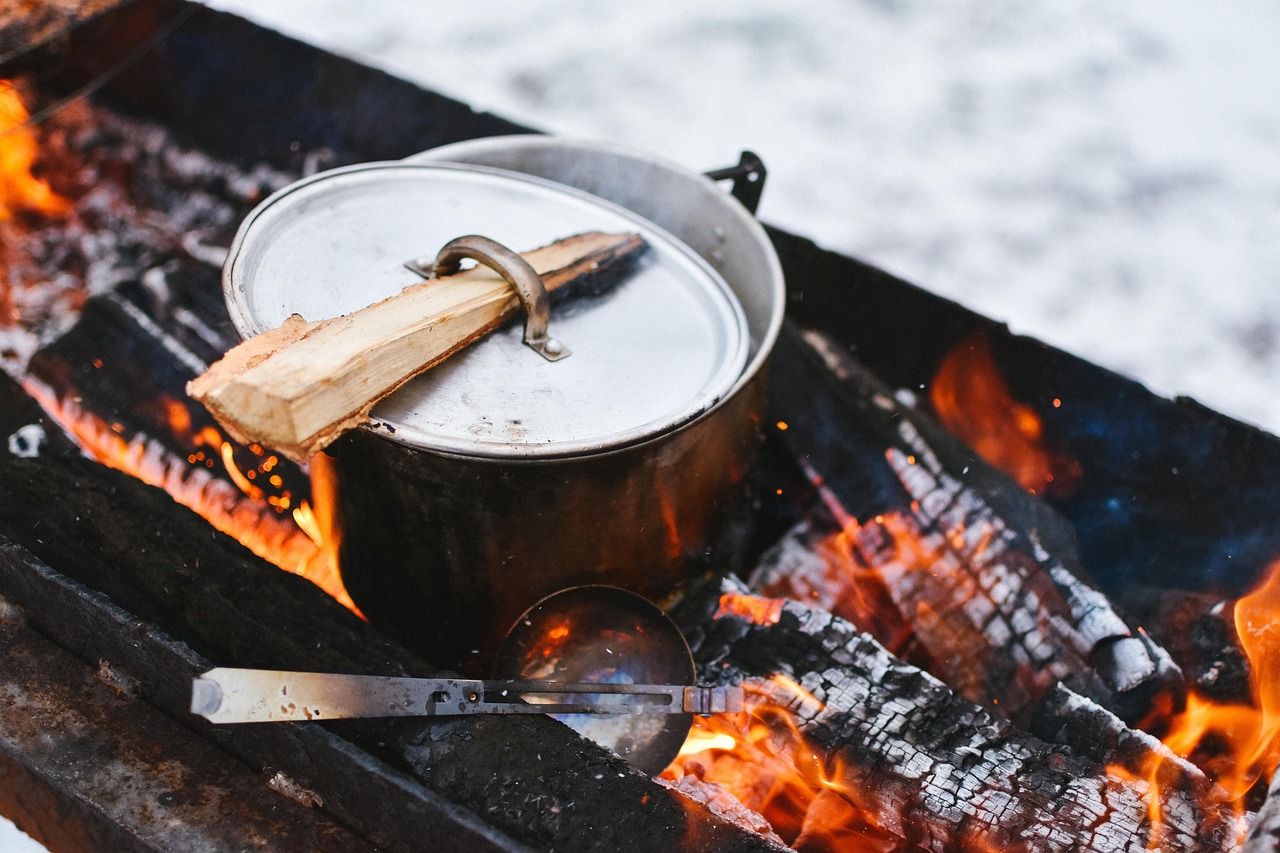
The wood fire still has its place when there’s a ring, dry wood and no burn ban. Fire rules change by county and by week, though, and an induction burner isn’t automatically allowed just because there’s no flame, so check with whoever manages the land.
As for timing, Black Friday is November 27 this year, and the kit splits neatly in two. Portable induction burners, cast iron and thermometers go on sale all year, so a Black Friday price is nice but not urgent. Power stations are different. Their prices swing hard around the holidays, and they’re the one piece of this kit where waiting two weeks can actually pay. Whatever you buy, plug it in and cook one dinner in the driveway before the trip. Finding out your outlet trips at level 8 is a lot less annoying at home than at a dark pullout at five o’clock with crunchy ramen on the menu.